Vol. 3 No. 1 (2026): Pavasaris
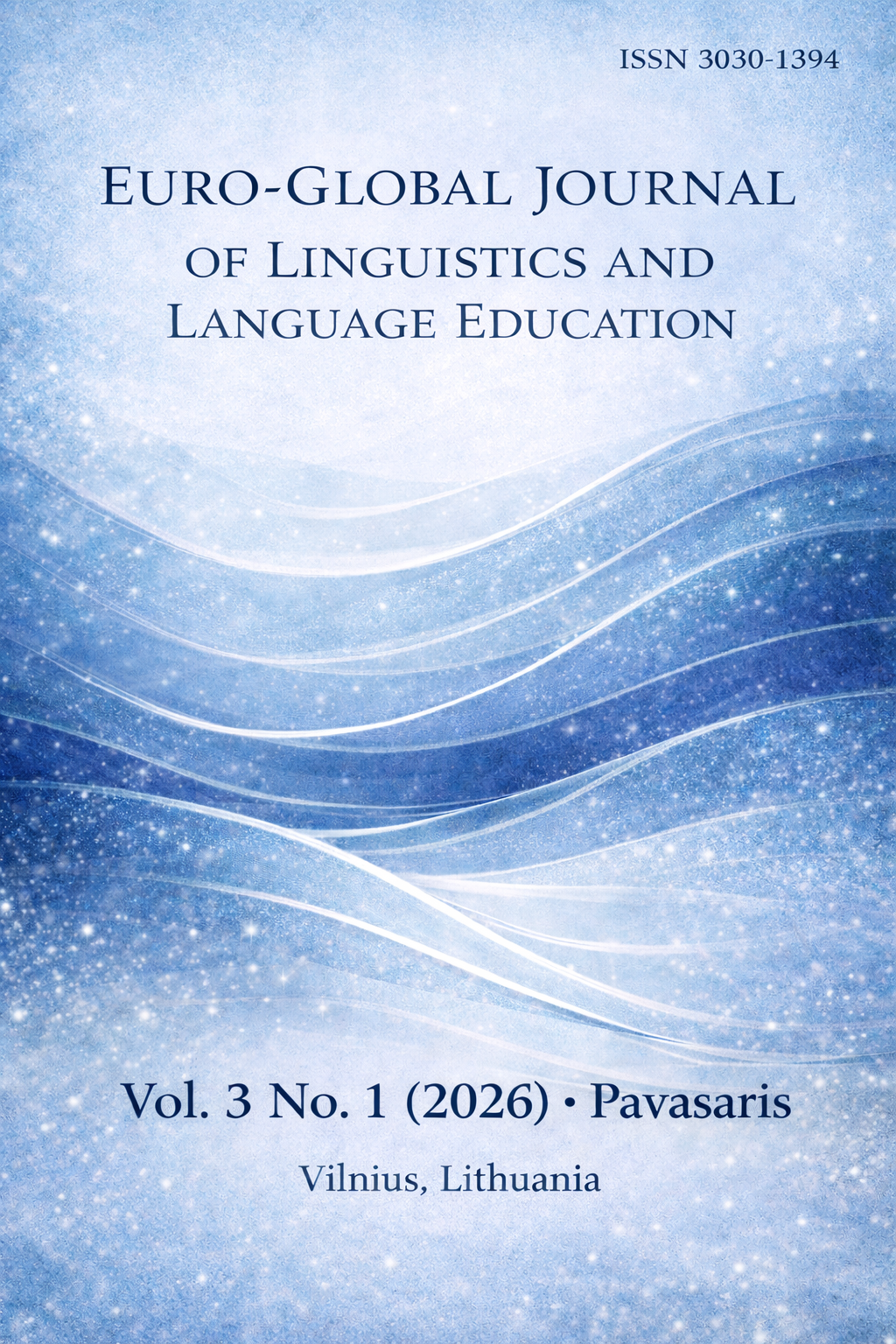
					View Vol. 3 No. 1 (2026): Pavasaris

Pavasaris is the opening issue of Volume 3 (2026) of the Euro-Global Journal of Linguistics and Language Education. Symbolizing renewal, development, and new academic perspectives, this issue presents original, peer-reviewed research in the fields of linguistics and language education.

As a general issue, Pavasaris welcomes scholarly contributions addressing theoretical and applied linguistics, language acquisition, bilingualism and multilingualism, language teaching methodologies, educational technologies in language learning, sociolinguistics, language policy, and translation studies. The issue aims to foster academic dialogue between researchers, educators, and practitioners from diverse linguistic and educational contexts.

This issue is published in a continuous publication format. Articles are published individually online immediately after successfully completing the peer-review and editorial processes. Once the publication period concludes, all articles are formally compiled into this issue.

Pavasaris reflects the journal’s commitment to academic quality, open access, and the advancement of research in linguistics and language education on a global scale.

Published: 2026-01-14

Full Issue

Articles

  • Main Strategies of Enriching the Neologism Dictionaries

    Emma Seidova (Author)
    4-13
    DOI: https://doi.org/10.69760/egjlle.2601001
  • From Mimesis to Narrative Modeling: The Evolution of Artistic Representation in Literature

    Nurida Ganbarova, Flora Mirzeyeva, Namiq Abbasov (Author)
    131-141
    DOI: https://doi.org/10.69760/egjlle.26010012
  • One Classroom, Many Levels: Combining Methods for Effective Language Teaching in Mixed-Level Classrooms

    Javid Babayev (Author)
    14-26
    DOI: https://doi.org/10.69760/egjlle.2601002
  • Riddles Formed on the Basis of Imperative and Interrogative Sentences in English

    Elnaz Aliyeva (Author)
    27-34
    DOI: https://doi.org/10.69760/egjlle.2601003
  • Modern Methodological Approaches in Teaching Russian as a Foreign Language

    Remziyye Esgerova (Author)
    35-41
    DOI: https://doi.org/10.69760/egjlle.2601004
  • Emerging Technologies and Pedagogical Innovations in Foreign Language Teaching

    Rubaba Mammadova (Author)
    44-55
    DOI: https://doi.org/10.69760/egjlle.2601005
  • Human vs. Machine Communication: The Future Value of English for Employability and Mobility

    Nermin Rzayeva, Ilaha Ashrafova (Author)
    56-64
    DOI: https://doi.org/10.69760/egjlle.2601006
  • University Students’ Patriotic Education Through an Interdisciplinary Approach

    Gunay Naghiyeva (Author)
    65-73
    DOI: https://doi.org/10.69760/egjlle.26010070
  • The Impact of Language Barriers on Nurse–Patient Communication and Clinical Errors

    Afsana Orujlu, Sevinc Adigozalova (Author)
    74-81
    DOI: https://doi.org/10.69760/egjlle.26010080
  • Assessing The Impact of Blended Learning on Early Childhood Education Teachers' Professional Development in Akinyele Local Government

    Olatunji Saheed Olawale, Abioye Jemimah Anuoluwapo Iyabode, Leye-Akinlabi Gbemisola Olufunmilayo (Author)
    82-98
    DOI: https://doi.org/10.69760/egjlle.2601009
  • AI-Assisted Scaffolding for Inclusive CLIL in Higher Education

    Khatira Mammadova (Author)
    99-105
    DOI: https://doi.org/10.69760/egjlle.26010010
  • Reproach Strategies and Reactions in Friendly Interaction in Cameroon

    Bernard Mulo Farenkia (Author)
    106-130
    DOI: https://doi.org/10.69760/egjlle.26010011
  • It’s Giving Linguistic Innovation: A Sociolinguistic Analysis of Gen Z Digital Slang

    Zarifa Sadigzade (Author)
    142-151
    DOI: https://doi.org/10.69760/egjlle.26010013